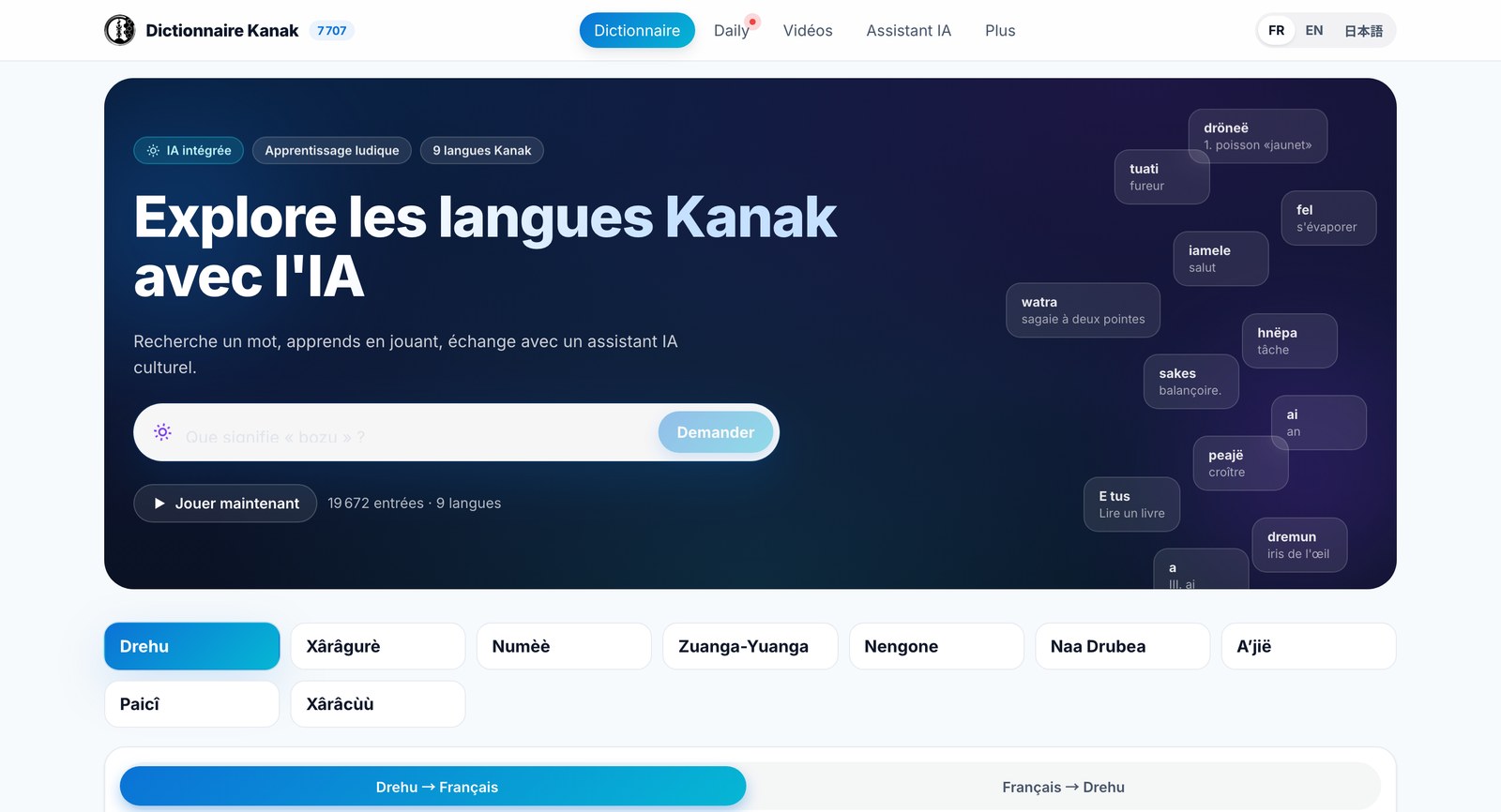
It is a free, ad-free online dictionary that brings together 9 Kanak languages of Kanaky (New Caledonia) and 19,672 words in one place: Drehu, Nengone, Paicî, A'jië, Xârâcùù, Xârâgurè, Numèè, Zuanga-Yuanga and Naa Drubea. You search a word in French, English or Japanese, listen to its pronunciation by native speakers (nearly 1,000 recordings), and ask questions to an AI assistant that relies only on verified content. It is available at dictionnaire.kanaky.xyz, from a phone, with no account.
Why this project exists
Kanaky (New Caledonia) is home to 28 Kanak languages, inherited from several millennia of presence on the archipelago. Many of them are now considered vulnerable or endangered: the number of speakers shrinks with every generation, and oral transmission — long sufficient — no longer is in a digital everyday life.
The paradox is that resources do exist. Linguists, academies, universities and associations have produced remarkable work: lexicons, recordings, learning methods. But that work was scattered — spread across out-of-print books, old apps sometimes no longer available, academic files, isolated websites. For a parent who wants to teach a word to their child, for a student, for a member of the diaspora far from home, finding and cross-referencing all of it was an uphill battle.
The dictionary was born from one simple observation: the material is there; what's missing is a single place — modern and free — to reach it.
The 9 languages, in numbers
The dictionary currently covers nine languages, from the three main customary areas to the Loyalty Islands. Here is the exact breakdown of entries:
| Language | Area / region | Words |
|---|---|---|
| Drehu | Lifou · Loyalty Islands | 7,707 |
| Zuanga-Yuanga | Kaala-Gomen · far North | 3,931 |
| Xârâgurè | Thio · Borendy | 3,337 |
| Numèè | Goro · Isle of Pines · Yaté | 2,161 |
| Naa Drubea | Païta · Mont-Dore · South | 1,367 |
| Nengone | Maré · Loyalty Islands | 556 |
| Paicî | Poindimié · Paicî-Cèmuhî area | 283 |
| A'jië | Houaïlou · Ajië-Aro area | 166 |
| Xârâcùù | Canala · Xârâcùù-Xârâgurè area | 164 |
| 9 Kanak languages | 19,672 | |
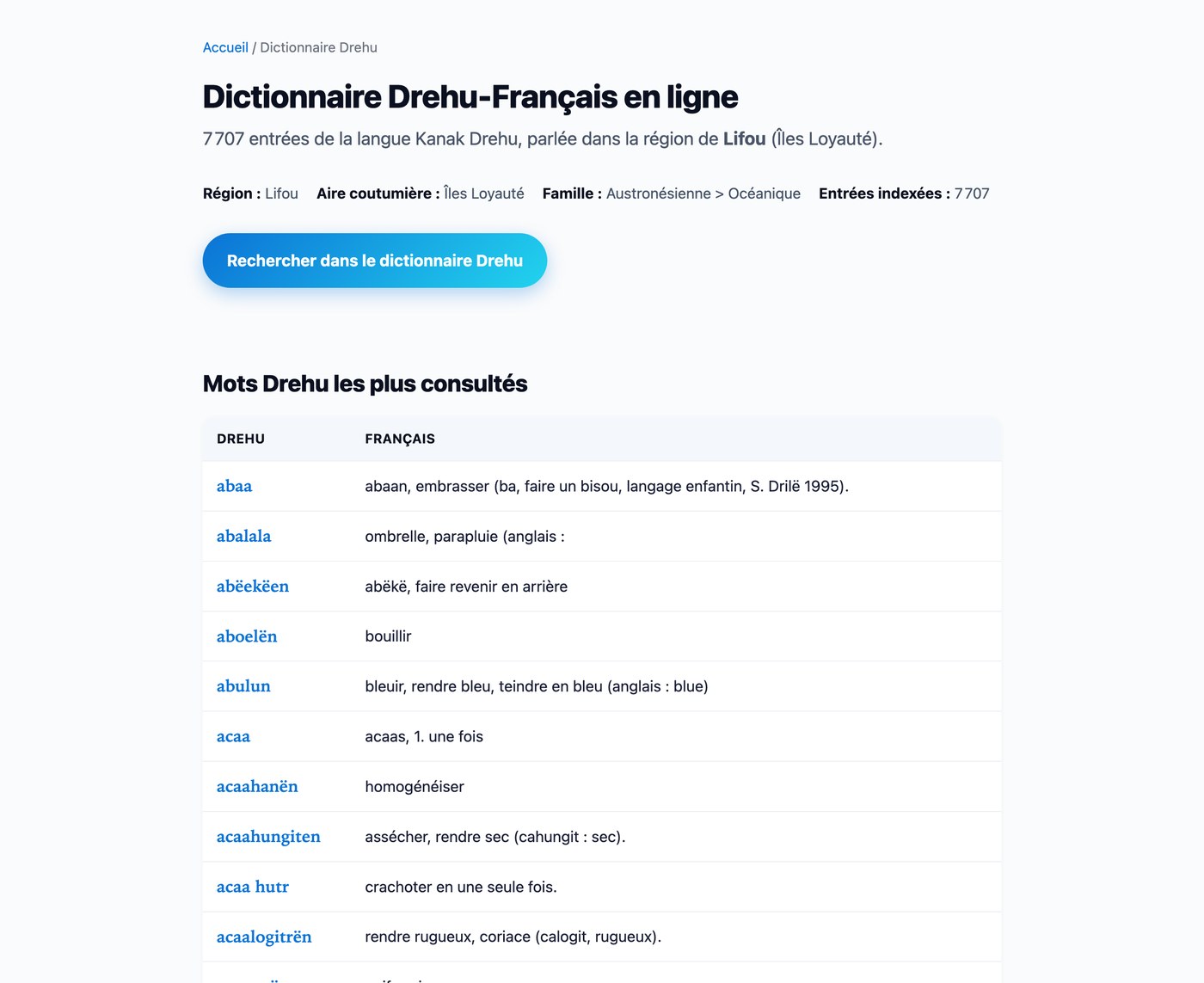
Drehu, the language of Lifou, is the best resourced with 7,707 words — it is also one of the most widely spoken Kanak languages. At the other end, languages like A'jië or Xârâcùù still hold only a few hundred entries: these are not "poorer" languages, they are the ones whose digital resources are yet to be built. The dictionary is designed to grow.
Hear them, not just read them
A language is meant to be spoken. That is why the dictionary includes nearly 1,000 audio recordings by native speakers — the real voices of people who speak these languages, not a synthetic voice. Audio currently covers five languages (Drehu, A'jië, Paicî, Xârâcùù and Naa Drubea); the others are being recorded. For many words, you can therefore read the definition and hear how to say it correctly, with the sounds and tones specific to each language.
An AI assistant that doesn't make things up
The dictionary offers a conversational assistant for asking questions in natural language ("how do you say hello in Drehu?", "what does this word mean?"). But it is built with a strict rule, essential when it comes to heritage: it first looks for the answer in the verified dictionary database, and answers only on that basis. In other words, it does not "guess" a translation that does not exist. This is a major difference from a general-purpose machine translator, which can produce confident but wrong answers — an unacceptable risk for an endangered language, where a repeated error can settle in for good.
Technically, this assistant relies on retrieval (RAG) paired with a language model, running on a lightweight, frugal infrastructure. It is exactly the kind of system Kanaky Tech builds for organisations that want reliable AI grounded in their data rather than in the open web.
How it was built
The heart of the project is not having "invented" these languages — that would be absurd and disrespectful. The underlying linguistic work belongs to generations of speakers, and to reference institutions such as the Kanak Languages Academy (ALK), the University of Kanaky (New Caledonia) and CNRS-LACITO. Kanaky Tech's contribution is elsewhere, and it is precise:
- Bring together. Gather resources scattered across heterogeneous media into a single, coherent base.
- Structure. Normalise tens of thousands of entries into one clean, queryable format — with a documented quality audit to flag missing definitions, duplicates and inconsistencies.
- Make accessible. Put all of it behind instant, multilingual search (French, English, Japanese), on mobile, for free and without ads.
- Preserve. Keep everything in an open, durable format, rather than trapped in an app that can vanish overnight.
In spirit, this is digital sovereignty applied to heritage: taking back control of a common good — here, languages — and making sure it stays accessible to the community that inherits it.
Explore the dictionary
9 languages, 19,672 words, native audio and the AI assistant. Free, no account, from your phone.
Open the dictionaryWho it's for
The dictionary is first and foremost for families and learners who want to pass on or (re)discover a language. But also for students and teachers who lacked a single, reliable tool; for members of the Kanak diaspora — in mainland France, Australia or elsewhere — for whom a digital link to the language matters twice as much; and for researchers and the curious who want to explore the linguistic richness of the archipelago. Everyone accesses it the same way: for free.
What's next
The project is deliberately evolving. Work in progress: completing the audio for the languages that don't have it yet, enriching the shorter lexicons, adding English and Japanese translations where they are missing, and above all opening up contribution. Every page already lets you suggest a word or a correction: it is the speakers and the language experts who, word by word, will make the base more accurate and more complete. A living language is never "finished" — neither is its dictionary.
The dictionary brings together 9 Kanak languages of Kanaky (New Caledonia): Drehu, Nengone, Paicî, A'jië, Xârâcùù, Xârâgurè, Numèè, Zuanga-Yuanga and Naa Drubea, for a total of 19,672 words. To our knowledge, it is the first online dictionary to gather them in one place, for free.
Yes, completely free and ad-free. It is available online at dictionnaire.kanaky.xyz from a phone or a computer, with no account and no sign-up required.
Yes. The dictionary offers nearly 1,000 audio recordings by native speakers for five languages (Drehu, A'jië, Paicî, Xârâcùù, Naa Drubea). Audio for the other languages is being added.
The assistant answers your vocabulary questions using only the verified content of the dictionary: it searches the word in the database before answering, so it does not invent a translation. It is a search aid, not a general-purpose machine translator.
The project is led by Kanaky Tech, a technology studio founded by Kevyn Wahuzue. The linguistic content builds on the reference work of institutions such as the Kanak Languages Academy (ALK), the University of Kanaky (New Caledonia) and CNRS-LACITO; Kanaky Tech gathered, structured and made it accessible in a single free platform.
Every page of the dictionary lets you suggest a word, a translation or a correction directly online. Contributions from speakers and language experts are welcome to enrich and strengthen the database.